“First Contact!”
The shout came from the group of professional astronomers and experienced amateurs who were collected at the edge of the plaza at the local Wuhan University which our group had reserved to watch the eclipse.
Excitement increased among the crowd of ninety Eclipse Chasers who had traveled from all over the United States, Venezuela, Columbia, England, and Canada. The noise level from the nearly 1000 local citizens mostly standing on the edge or the plaza rose also though it was obvious they were less clear on what was happening.
First Contact refers to the first moment that the edge of the moon touches the disk of the Sun. From that point on begins what is both the longest and shortest periods of time that any of the observers will experience. First Contact in Wuhan was called out at around 8:15 am, three hours after our bus left the hotel and five hours after the first of the three buses had left the hotel; that first bus carrying those people with telescopes and specialized photographic equipment.
Totality would not start until close to 9:30am. This period of time for the professionals was continually busy but for those of us who were merely enthusiasts it was a time for discussing what was going on, looking upward periodically with our ‘special’ glasses to see the increasingly large chunk of the Sun rising up in the sky as the moon seemingly dropped down over it; as the nervousness over the increasingly problematic cloud cover caused the entire scene to slip in and out between the clouds.
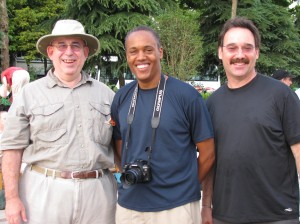
We were also entertained by a special guest, Alvin Drew, an Air Force Colonel, a US astronaut, and a recent visitor to the Space Station. Alvin had read about the eclipse, and our group, from a New York Times travel article, and talked about it a while ago with the author of the article. He had never seen an eclipse before, was spending a year in Moscow working with the Russian space program, and decided it was close enough to hop over to Wuhan. Thus he flew into Wuhan from Moscow the day before.
Everyone had their picture taken with Alvin including me.
As we got closer to totality, a number of group members started handing out extra copies of our protective filters which allowed viewing directly of the Sun to the local Chinese. The local Chinese crowd continued to grow in size and noise level.
“Two minutes”, came the shout as what was left of the Sun vanished behind the clouds, unfortunately not visibly behind the moon.
By then it had started to cool down noticeably from the extremely hot day in Wuhan which eventually got to 100 degrees. The light had shifted to the blue part of the spectrum, everything had gotten darker. The long wait when little seemed to change became a faster and faster maelstrom of events.
“Thirty seconds to totality”.
My daughters and I looked behind us away from the Sun and saw the approaching darkness. My older daughter gripped my arm tightly as the almost physical movement of dark came closer quickly.
“Totality”.
And almost instantaneously even though the Sun and moon were both behind the clouds, everything became dark. The crowd burst into applause briefly.
The hundreds of photographic flashes that suddenly came out, all from the local crowd who didn’t understand why they needed to tape over their flash, was less of a negative since the clouds prevented viewing much more effectively than the flashes would have.
The crowd quieted down and we began to hear crickets chirping louder and louder as they assumed night had fallen.
“Half-way through totality”.
Coolness on the skin. Night when there should be day. Strange night sounds when there should be silence. The collective special feeling being part of one of nature’s truly unique events.
“Come on, come on”, came voices from those with binoculars, most of whom had traveled thousands of miles to see the eclipse. Vainly looking for something in the now night sky.
Suddenly a shout, “Was that a light, over there?”
And through a brief gap in the clouds all suddenly saw the incredible sight, which photographs easily accessible on the web, do not convey accurately the power of the sight. The blackest circle that one has ever seen, with the Sun’s atmosphere brightly surrounding the black circle.
A loud cheer erupted. Eclipse virgins as first time viewers are called, were awestruck, amazed.
“Thirty seconds to go.”
The Moon and Sun continued on their separate paths, but as they did, the first light of the Sun shown brilliantly at one point of the Moon as well as around the entire disk creating a beautiful diamond ring for an instant as the day then returned.
Applause again as the total eclipse ended though the entire event still had more than another hour to go until the two bodies were completely separate. However, it doesn’t take much of the Sun to be visible day to return.
While those of us who had been to previous eclipse’s were disappointed that we had only seen a part of this one, we were very happy to have seen what we did and thrilled to share the experience with still another group who have been initiated into that small group of umbraphiles who have experienced this very special event.
It took many hours to come down, or up, from our reaction to the eclipse, but by evening we had left Wuhan and moved on to Xian to continue the other part of our trip, the tour of China.
Hi:
Would you like a photo or two to go with your blog? Just email me and I will send some on. Only request is to credit them.
So how was your trip home? We got to our house by 8 pm and Connor recovered in an instant with his farmilliar surroundings. He sure wilted in the second flight of the day.
Take care
Murray
Comments are closed.